.png)
Bennet Marks, a software engineer and gay rights activist based in Sunnyvale, California, built gay employee groups at two of Silicon Valley's most influential companies — Apple and Google — decades apart, and the nondiscrimination policies, domestic partner benefits, and workplace protections that followed him are still in effect today. Born in 1954 in Levittown, New York, he came to California for graduate school in mathematics at Stanford, earned his master's degree, and landed in the South Bay tech economy just as it was beginning to define itself. In 1981, he obtained a federal security clearance at Ford Aerospace in part because he was not yet openly gay — not even to himself.
Coming out was gradual. As he began to find his footing, Marks joined a gay men's discussion group at Stanford, where he met Kim Harris, a computer scientist and fellow activist who would become his lifelong partner. The two began a relationship in November 1982 and married in September 2008, weeks before California's Prop 8 stripped that right away — temporarily, as it turned out. By 1983, Marks was plugged into the broader network of gay tech workers forming across the South Bay, drawing on the energy and intelligence of groups like High-Tech Gays, which was actively challenging the federal government's discriminatory security clearance policies in court.

The arc of his activism begins at Apple, where he arrived as a software engineer and would eventually do some of the most consequential internal organizing in Silicon Valley history. In August 1986, drawing on what he'd observed through High-Tech Gays and his own experience on Apple's AIDS Response Committee, Marks founded Apple Lambda — the company's gay and lesbian employee organization, named for a Greek letter that had quietly emerged as a symbol of gay identity. He came out to the entire company in the process. Membership spread by word of mouth, welcoming in employees who were otherwise afraid to be visible.
What Apple Lambda accomplished in the years that followed was structural. The group is widely credited with pushing Apple to adopt formal nondiscrimination policies, making it by most accounts the first Silicon Valley company to do so, and later, domestic partner benefits. Apple Lambda marched in the San Francisco Pride Parade beginning in 1987, publicly staking out what was now acceptable inside a major tech company. That signal traveled. "Apple then was Apple; Apple now is Apple," Marks later said. "It was my very strong opinion that anything we did at Apple would have ripple effects throughout Silicon Valley and throughout the country." He was right. The work preceded state law — California didn't codify nondiscrimination protections for sexual orientation in its Labor Code until 1992.
Marks left Apple in 1997 and joined Google in 2004, at a moment when the company had all the right policies on paper and almost no visibility around them. During his recruiting process, he asked whether Google offered domestic partner benefits. His recruiter didn't know. To someone who had spent years fighting to make those policies legible inside Apple, the answer was telling — not of the company, but of how the company communicated what it stood for. One of the first things he did after getting a desk was call HR to address it.
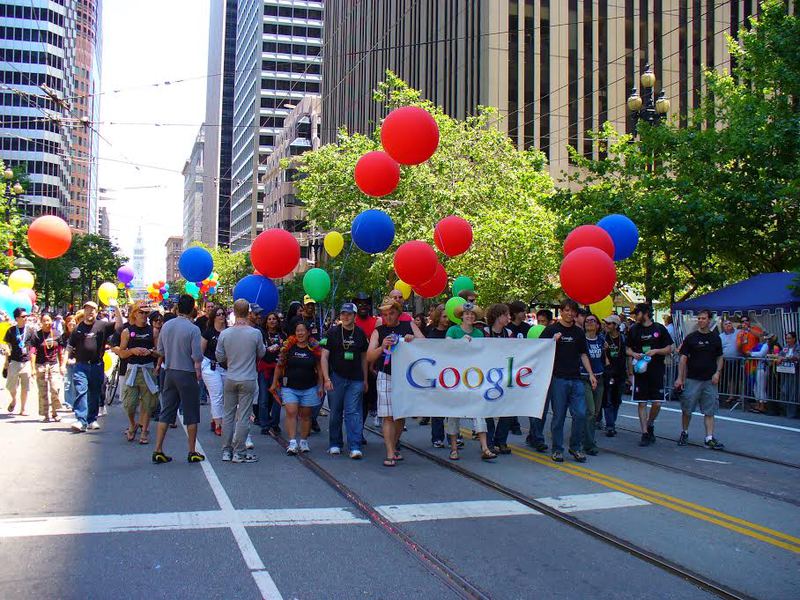
The Gayglers, Google's LGBTQ+ employee group, emerged in 2006. Though Marks didn't name them or call the first meeting, he became the group's first coordinator and one of its most active architects. The Gayglers became the first grass-roots employee diversity organization at Google, and their model seeded others — the Black Googlers Network, the Hispanic Googlers Network, the Greyglers. In 2010, working with Google's leadership, the Gayglers helped eliminate the effective tax penalty applied to domestic partner benefits, by having the company compensate employees for the added tax burden that same-sex couples carried in the absence of federal marriage recognition.
Marks retired from Google in 2011 and continues to live in Sunnyvale with Harris. What he built across three companies and three decades is a reminder of what patient, persistent internal organizing can accomplish. He formed groups where none existed, in eras when the wrong conversation could end a career. He came out to an entire company. He made his pitch at all-hands meetings and figured out who needed to be in the room. "I think every generation paves the way for the next generation," he said. "I believe that the Silicon Valley corporations had a direct impact on protections going through the legislature." The tech industry is once again in a moment of retreat from the protections that people like him spent decades building. But what cannot be undone is the legacy of the queer tech community itself — the networks, the coalitions, the institutional knowledge, and the proof that change is possible from the inside.
References & Readings:
My Life with the Gayglers by Bennet Marks
Queer Silicon Valley