
I'm one of those people who loves to life plan, from mood boards to goal tracking. There isn't a thing I haven't tried. I really love being able to have something to strive towards. But there's a lot that goes into planning and coordinating, so here's how I plan for my year ahead, using astrology, technology, and good old pen and paper.
The Power of a Personal OKR or Goal
I got into goal planning because of my corporate work. When I finally became a manager in my corporate role, I was tasked with setting OKRs (Objectives and Key Results), and it clicked: why wasn't I doing this for my own life? The framework that helped me achieve company goals could work for personal and professional ones too. And honestly? It's been one of the most empowering practices I've built. Not only for the fact that I feel like I'm working towards something, but it also gives me the opportunity to reflect on my life and work, and be proud of something while also striving for more.
I'm incredibly career-driven, so understanding how to structure my ambitions matters. But this system works for everything: creative projects, finances, health, spirituality. If you're someone who straddles the corporate and creative worlds, who has big ambitions but also needs flexibility, this approach might resonate.
Structure is really important to me. I've written about how I use structure in other areas of my life. If you're kinky, you might find this writing about kink and goal setting of interest. But the foundation is the same across the board: I need frameworks that help me move toward what I want while giving me room to adapt when life happens.

The Process of Planning
When I plan for my year, I make an entire day of it. I'm talking luxury. I go somewhere that feels grand and comfortable, treat myself to a good lunch or cocktail, and set myself up in a space that takes me out of my routine. I'm a Taurus, so this kind of indulgence isn't optional; it's part of the process. Being in a place that feels expansive encourages me to dream bigger and want more for myself.
I'll even create a playlist that matches the emotions I want to feel for the year ahead. I prep my materials in advance. My calendar's already populated with astrology dates (more on this below), my Notion template is ready to go, so I'm not wasting time on admin when I should be visioning. Then I pour everything out. Every goal, every ambition, every wild idea. After that first session, I take a break—sometimes a hour, sometimes a day—and come back for refinement. Planning your year is sometimes a multi-day process, and that's okay.
I think a big part of this is understanding how you succeed. Do you need to be comfortable at home? Great, get the space prepped. Are you a visual person? Make a collage. Whatever it takes to get you there. For what it's worth, I've made both collages and Pinterest boards and have found both to be fun and helpful in their own ways.
How I Build My Goal Framework
Each year I start with a theme. 2025 started as "the year of growth" but became "throwing caution to the wind" after a layoff. From there, I break down my goals into categories. Typically these include career, financial, creative, physical/health, spiritual, beauty, and miscellaneous. Granted, these will be unique to you.
From there, I set yearly goals for each category and then break them down quarter by quarter, eventually getting to month-by-month milestones. For me, it's hard to understand a goal in the abstract. "Appear on a podcast" doesn't mean anything without a plan. So I set monthly targets: pitch five podcasts, research shows that align with my expertise, follow up with previous contacts. Breaking it into actionable steps made it real. It also creates actions that keep me accountable to my goal. It could be very easy to check back in December and be like, "Wow, I didn't make my goal." Instead, I feel like it increases the likelihood of reaching your goals because you are doing the work. And if you don't reach them? Hey, this way you can say, "Wow, I reached out to X amount of people, and I improved my pitches."
Other goals, like financial ones, are more straightforward. If I wanted to save $12,000 in a year, that's $1,000 per month. Then I could break it down week by week based on my pay schedule. Maybe $400 the weeks when I get paid, $100 the weeks when I don't. It's granular, but that's how I actually reach the target.
The key is making goals concrete enough to track but flexible enough to adjust. Because let me tell you: your year can change in an instant.
When Plans Change
Last year, I didn't plan on getting laid off. But very early into 2025, I was, and all my goals had to pivot. That was hard. Really hard.
What I didn't anticipate was the emotional complexity that hit me around the six-month mark, when I fully started processing two layoffs in two years. I'm tough on myself about goals, and I don't always give myself the wiggle room I need when life throws curveballs.
So here's what I've learned: be flexible. Your goals are for you, not against you. If circumstances change, your goals can change too. That doesn't mean you failed—it means you adapted.
The Tools I Use for Goal Planning
Notion for Goal Tracking
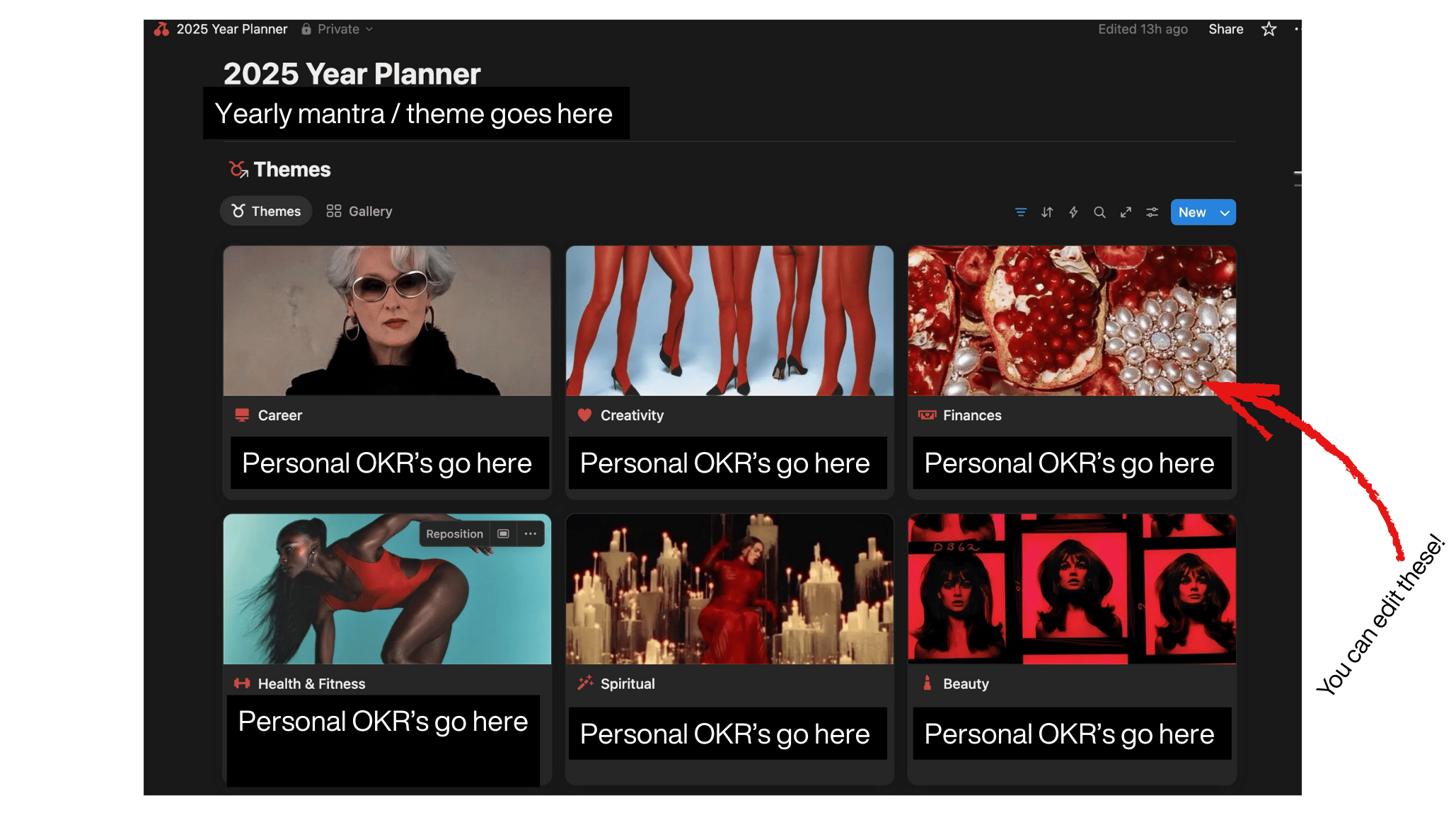
I track everything in Notion. I use this template from Notion with Tori, which I've customized extensively. There are a bunch of different templates from other creators you can use depending on what you like. You can start with any template and adjust it to how your brain and lifestyle work.
My setup includes all my categories (finance, career, physical, etc) with visual themes on the first page, then individual goals broken down by quarter. I don't use trackers; they add anxiety for me. I'm a check-it-off-the-list person.
The beauty of Notion is the customization. I make my boards look pretty because I want to engage with them. I change icons, add images from Pinterest boards I've made for the year, and create an aesthetic that makes me excited to open it. If your planning system doesn't make you want to use it, you won't. Notion in particular is really cool because you can even change icon colors.
Golden Coil for Weekly Execution
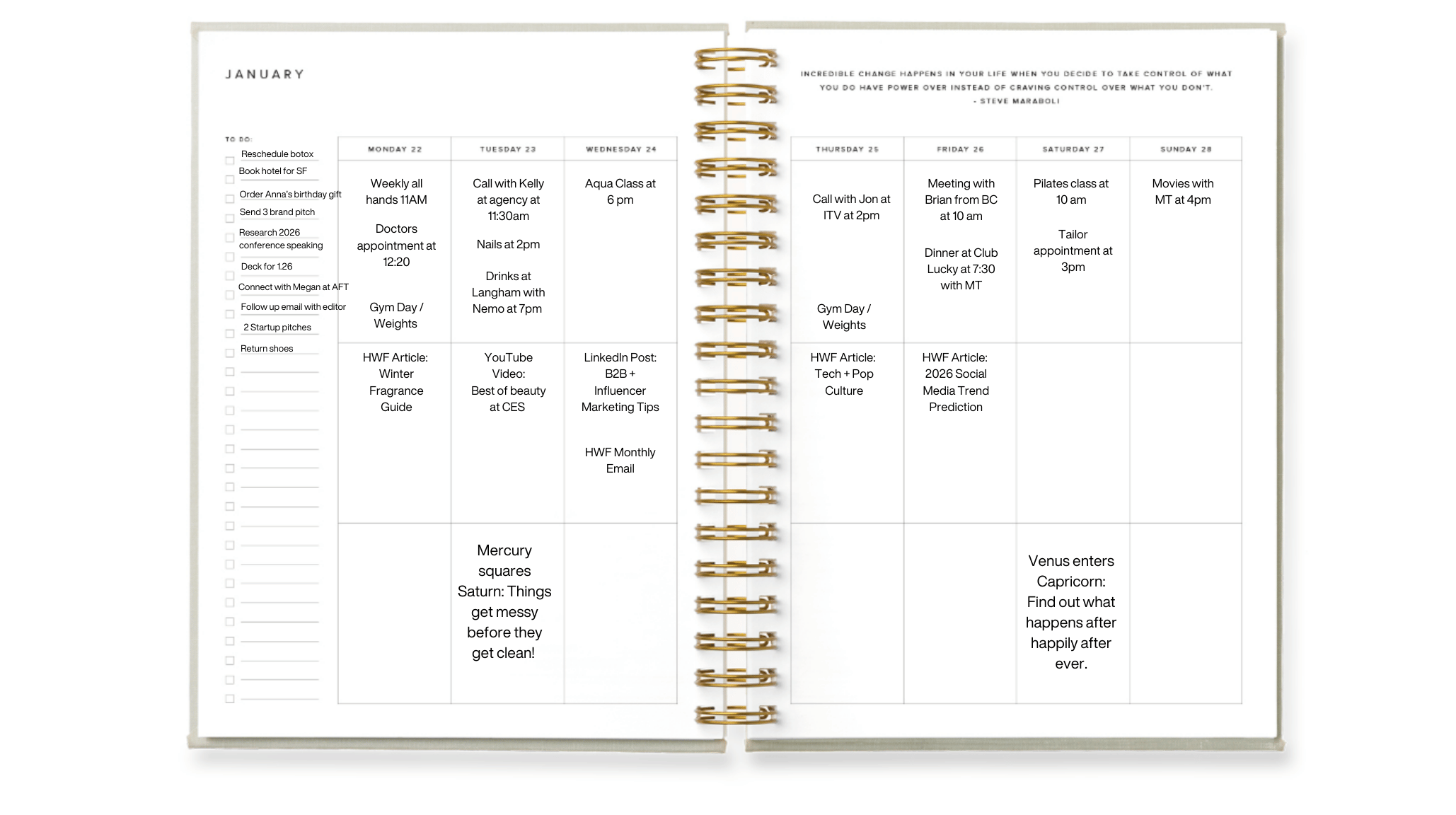
I've used Golden Coil planners since 2020. They're incredibly customizable. You can choose your layout, add trackers for finances or habits or meal planning, and build exactly what you need. You even choose the date layout.
I have spent the last few years perfecting my build for my current life. Right now I use their vertical 2 double-page weekly layout. Each day is broken into three large boxes. I section my weekly pages into:
- Meetings and appointments
- Content and projects
- Spiritual and astrological notes for the week
In the beginning of the month, I have a general overview of the month. I note especially large projects, birthdays, travel, or astrology dates. I also use their finance template at the beginning of the month. In here, I track all sources of income, savings, major expenses, investments, and of course my credit score. I get off on seeing it written; I'm a freak, ok! I also inserted a blank page where I include all the monthly goals from my Notion template with even smaller weekly goals. I track some other things as well and have a space for an end-of-month recap.
Other tools I sometimes use: Monday.com and Asana for work/agency task planning and content tracking, though I haven't personally used them for personal goal planning. I think they could both be adapted to personal goal planning.
Astrology for Energy Management
Here's my take on astrology: I use it to understand energy, my own and the world's. I don't think it's hard and written in stone. Astrology is a tool for understanding energy, and it's powerful if you find power in it. It's subjective, and that's fine. If there's an astrologically tense moment, I'm more mindful with my communication, perhaps being less pointed with my tone, more understanding of being misunderstood. If Mercury's retrograde and technology might go haywire, I don't push big launches on those dates.
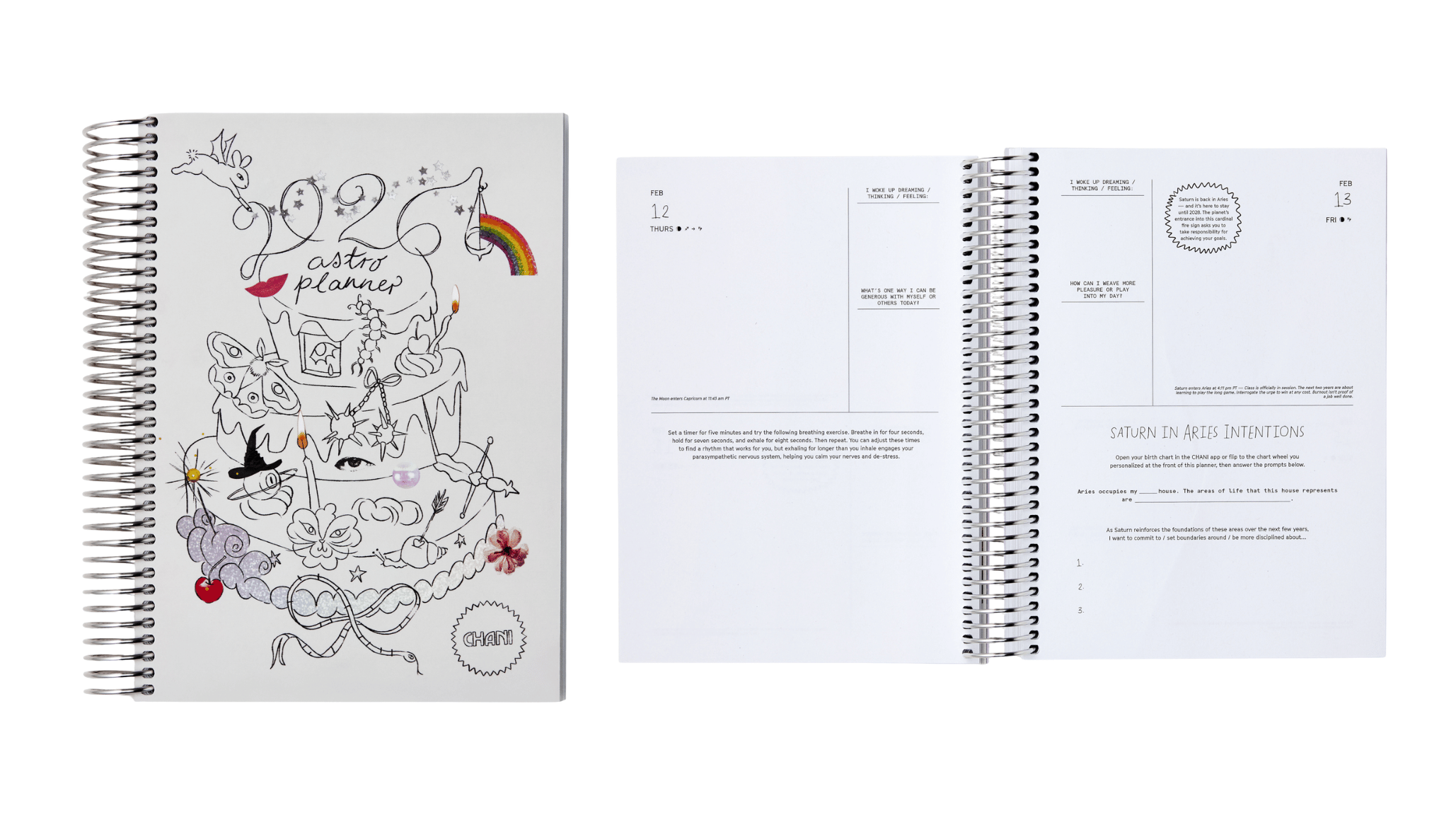
I source all my information from Chani Nicholas. I buy her digital planner every year and transfer the key dates into my Golden Coil by hand. I imagine you could also integrate this into your Google calendar. Chani does have a physical planner with a ton of really interesting prompts that's really great, but just not big enough for all the moving parts of my life. I have, however, bought physical copies in the past to journal in and do her prompts. She also has some other astro tools that have been helpful to me.
I also listen to Chani's Week Ahead podcast every Monday morning. It's part of my ritual, and I've noticed that the weeks I skip my Monday ritual are significantly harder for me. I appreciate the intentionality that my ritual allows me to set for the week. I think everyone should have some kind of ritual to set them up for the week ahead, get the energy right to set yourself up for success.
I specifically use astrology for launching creative projects. I try to understand when I might be more likely to strike creative genius, or when I might be in a rut, and I plan accordingly.
Looking to the Year Ahead
Goal planning is beautiful and powerful. It gives structure, and structure is important to me. But you have to give yourself grace too.
Your goals are goals for a reason; they might not be 100% attained, and that's okay. I can get very bogged down by details and very upset when I don't reach everything. But eventually, something will happen if you put in the work. Small habits over time do add up to change.
I think sometimes some people want to shame people for having ambition, or for caring, for dreaming beyond their current circumstances. Don't let them. Don't give them that power over your future. I truly take the approach of: if I don't want their life circumstances, I don't take their advice, or in some cases, feedback. Because sometimes feedback is really just projection in disguise, and it's important to discern when that's the case. At the end of the day, don't be afraid or ashamed of having ambition. Don't think it's uncool to want things. You just have to find the middle ground that works for you and find the tools that support you. What works for some might not work for you. Keep at it. Pivot when you need to.
I hope this next year brings you everything you're looking for, and I hope you reach a lot of your goals.
Like what I have to say? Support me and subscribe to my newsletter.