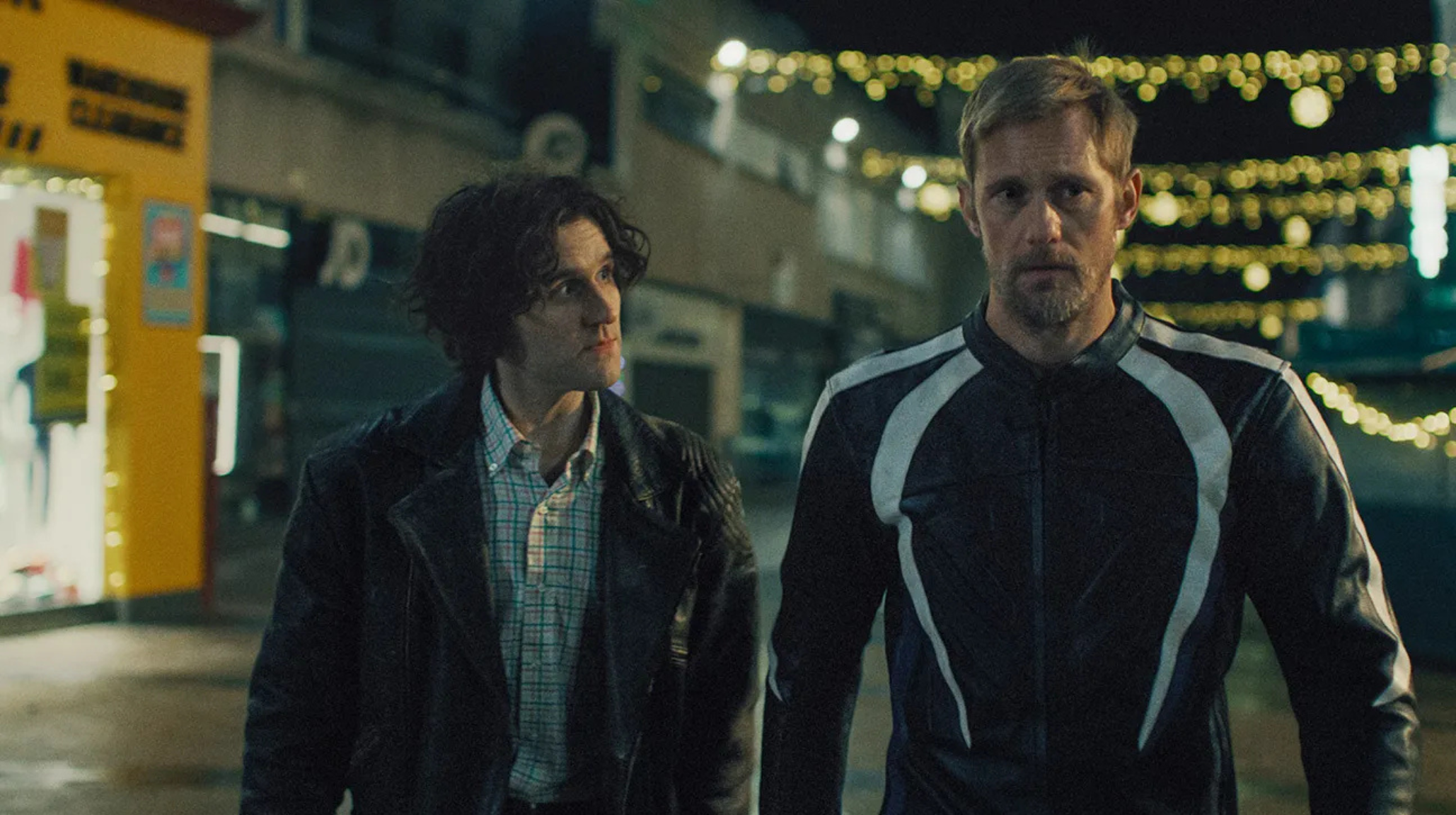
Wake up babe, we've got a new Christmas movie for the rotation. Carol turned up to a thousand. This time it's far freakier, and like much of the internet, I have opinions about Pillion. I went into the film mostly clean: no spoilers, minimal discourse engagement, just years-old fantasies of Alexander Skarsgård as Eric Northman from True Blood fueling my anticipation. And much to what I imagine is the disappointment of certain freaks, unlike True Blood, this film featured zero blood play. What it did feature was something I'm always eager for: a genuinely complicated look at the emotional architecture of a BDSM relationship — the power dynamics, the stumbling, the growth, and the very human wreckage that can come from two people building something they don't quite know how to hold.
Full disclosure: this will have spoilers, and it is entirely framed through my own lens as a queer dyke who is very much not a biker, but rather a lifelong passenger princess. I don't share the same identities or lived experiences as these characters. What I do share is a familiarity with certain dynamics — the kind that, if you've spent any real time in kink spaces, you'll recognize on a cellular level. My connection to kink is born in part from trauma, in part from being overly curious, and after a decade of therapy, what I've come to understand is that there is some connection to familiar dynamics, which I connected with more than I care to admit.
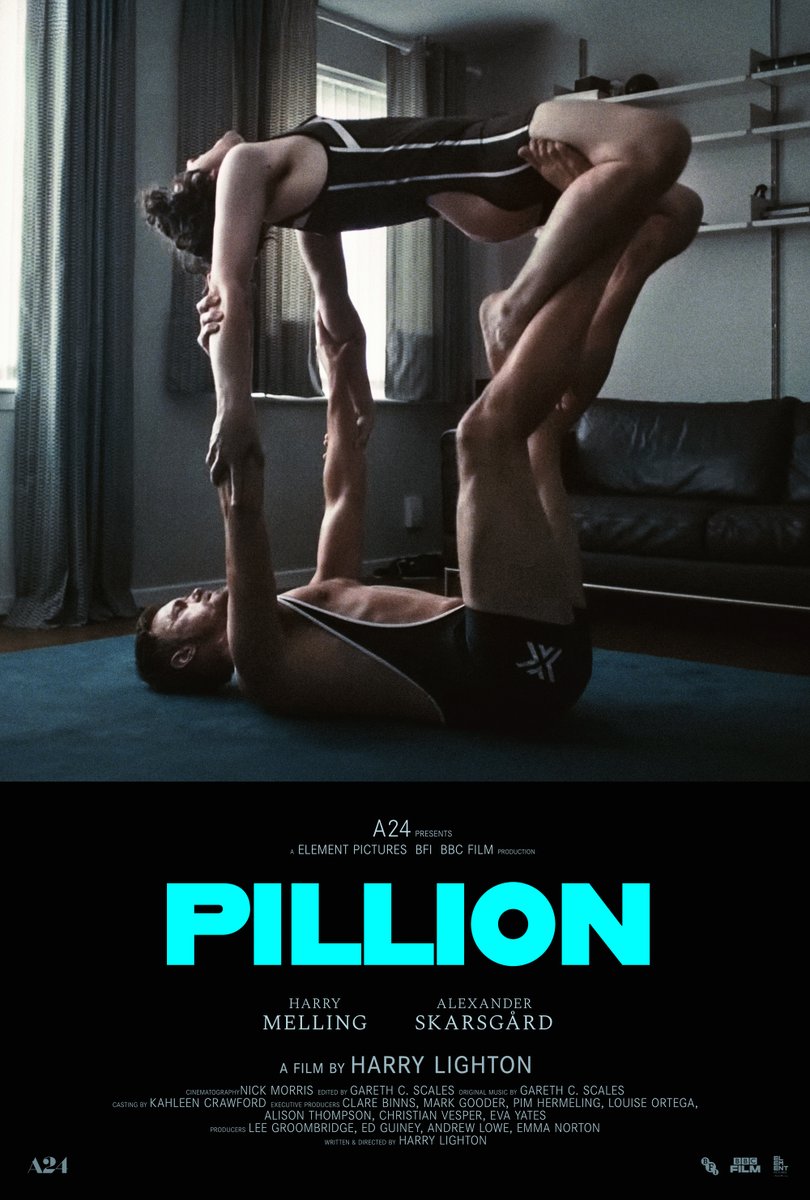
So. Pillion.
What the film captures beautifully is the way you arrive at kink. The meet between Colin and Ray doesn't happen through a carefully researched foray into the scene. It happens by chance, the way a lot of things do. A pub, an acapella performance, a note slipped across a bar like a very festive proposition (new fantasy unlocked, as someone who is very much a lover of Christmas, please proposition me for cruising via Christmas cards in the future). Then a location, a time, and a clumsy but undeniably erotic alley encounter that sets the whole thing in motion. I appreciate this so much because I think there's a mythology that people who end up in kink always had some lifelong inkling, some deep internal compass pointing them there from the start. And yes, some people do. But for a lot of us it's a chance collision. It's awkward and thrilling and not at all what you expected, and then suddenly it's just your life.
The film doesn't spend much time on explicit negotiation between Colin and Ray. No formal boundary-setting scenes, no contracts, no aftercare discussions. I know this is where most of the criticism lands, and fair. But I also think it's honest in a way that's uncomfortable to admit. When I first started playing, I didn't have the language for my own limits. I didn't fully understand that my desires and my pleasure were supposed to matter as much as my partner's, that I was allowed to name what I needed and have it taken seriously. My entire frame of reference for BDSM at that point was that genuinely unhinged scene in The L Word where Jenny Schecter visits a dungeon mid-spiral, which, for a number of reasons, was not setting me up for success. The result was dynamics where the implicit vibe was: shut up, submit, service, and be grateful. I think a lot of people, especially those newer to the scene, will recognize that shape, even if it makes them wince.

I do think the culture has shifted significantly since the inception of Jenny Schecter, or my own foray into play. There's more visible love for subs now, more discourse around their needs and value within a dynamic. Though I will say, to my dismay, brats are still somewhat misunderstood, often reduced to a problem to be corrected rather than a particular flavor of submission that deserves its own respect. But even that conversation has moved. The film sits in an older register of these dynamics, and I don't think that's a failure. I think it reflects something true about how these spaces have historically operated, and there's value in seeing that on screen rather than pretending we've always been doing this well. I also think it's a bit reductive to expect a film to make you comfortable every step of the way. This one provides ample room for reflection, for kinksters and vanilla people alike.
At the same time, Pillion isn't only showing you the difficult parts. The camping scene is genuinely warm: Colin finding community, belonging, a kind of ease he doesn't have elsewhere in his life. There's a character who checks in, who notices something is off and says something, which matters. The film is not arguing that all of this is fine and correct. It's showing you the full spectrum, including people who are trying to look out for each other.

The collar and the shaved head get dropped into the film without explanation, which I know frustrated some viewers. Honestly, I go back and forth on it. For those of us who understand the weight of collaring, what it signals about commitment and ownership within a dynamic, Ray's eventual wordless disappearance hits differently. It lands with the specific sting of someone walking away from a promise they made with their whole chest. For viewers who don't have that context, some of that resonance is lost. But I also wonder if we've become so dependent on being explained to that we've lost patience for learning from context. The collar is there. You can look it up. And maybe for someone encountering this for the first time, that moment of wait, what does that mean is actually the beginning of something.
The growth arcs are where I want to spend some time, because I think Colin's is legible and Ray's is mostly implied, and I find the implied one equally interesting.
Colin at the end of the film is on to something new, meeting a new dom named Darren. He has updated his profile. He has boundaries he can articulate out loud, needs he can name without apology. He is back to his acapella hobby, returned to himself but only slightly different. The 24/7 dynamic asked a lot of him: his autonomy, his routines, the full surrender of his daily life. Coming out the other side, he knows what he actually wants from it. Not less kink. Just kink where he also has power.

Throughout the film Colin is clearly navigating a difficult time, his mother dying of cancer. We see his family dynamics pretty clearly too. His mother is somewhat overbearing, eager to put a bow on Colin's life as she faces death, which honestly I can understand. But it's also clear this has been a lifelong dynamic of sorts, with some sense that Colin has always been a bit coddled, never quite given full choice. In the first scene his mother is setting him up with someone (although I would also set my gay son up with someone in a Free Britney shirt, so maybe I'm the problem). It's clear that perhaps Colin hasn't always had complete autonomy in his own life, and that's part of what makes the dynamic with Ray feel comfortable. He chose to be there. As someone with a complicated family relationship, I get it. For me, BDSM has been a place where I can comfortably push on my own history and explore parts of my pain that have spilled into other areas of my life. But like Colin, it's very easy to overdo it, especially when it's new and tingly. Which makes his trajectory all the more obvious in hindsight.
Ray is harder. Ray disappears, which is cowardly, but I don't think it's random. The burned hands are the turning point for me. Colin, hours after his mother's funeral, grabs a hot pot bare-handed. This is not a scene moment. This is a man who has been cooking the same way in the same kitchen for months, and so this sudden change in routine should have raised some flags for Ray. Colin then proceeds to go on a sub crashout of a lifetime shortly after. Ray helps, and then almost inexplicably agrees to Colin's needs. They have one real day together: the cinema, the park, the first kiss. And then he's gone.
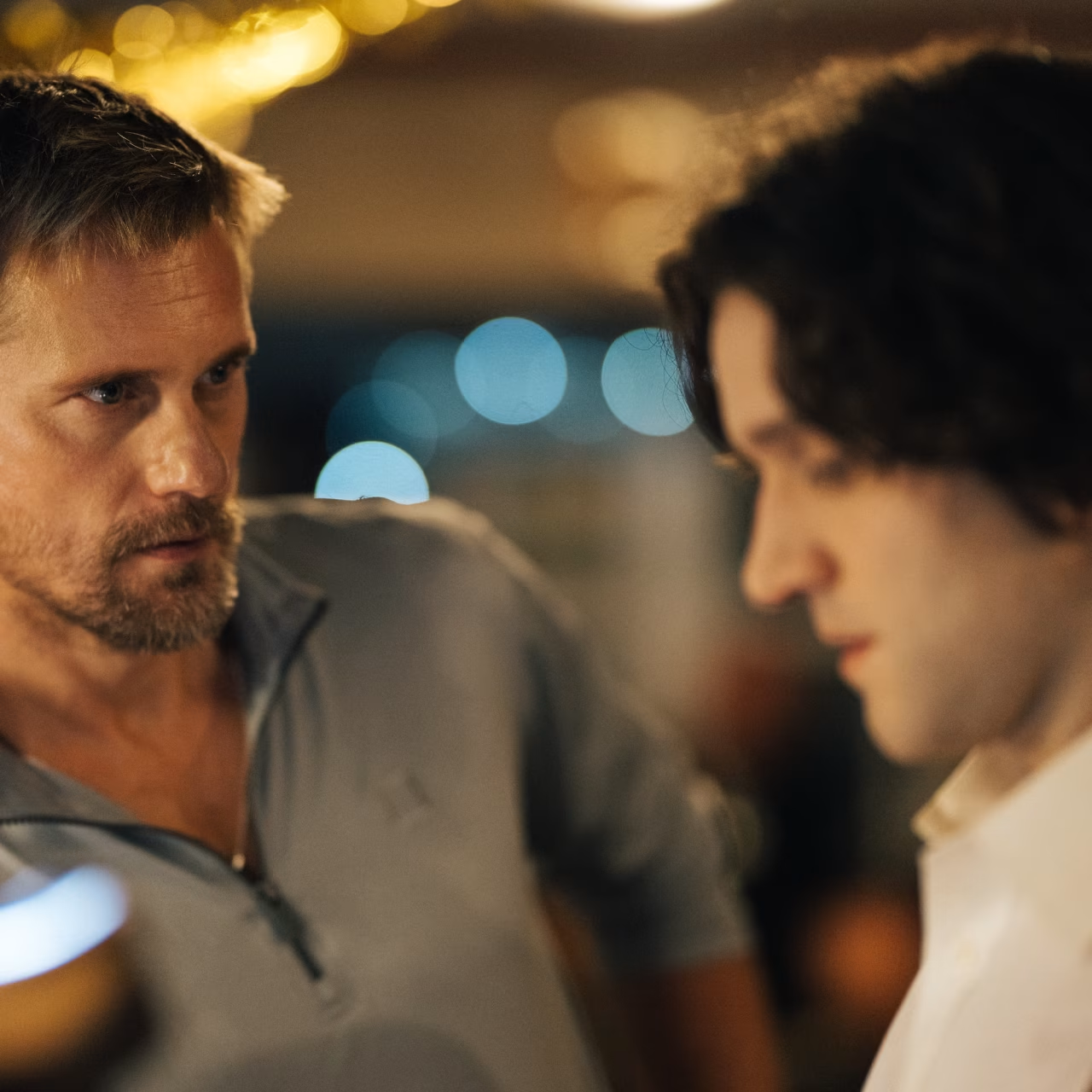
I think Ray left because of the burned hands. A 24/7 dynamic requires a particular kind of vigilance, and Ray didn't have it, at least not then. If your sub is picking up hot pots and inflicting pain on themselves after the most destabilizing event of their life, and you missed it, that tells you something about the quality of your attention. I think confronting that, not as a villain but as a person who thought he was more capable than he turned out to be, might have been more than he was ready for. And so he left. Which is very human, and also kind of gutting.
I've been in dynamics that were unbalanced. I've been in situations where I gave more than was sustainable and didn't have the language to say so, or said it and wasn't heard. That's not unique to kink. It maps onto all kinds of intimacy. But there's a particular vulnerability in BDSM spaces because the power is so explicit, so named, and so easy to mistake for something stable when it isn't. What I found in this film, and what I keep finding myself grateful for, is that the messiness is allowed to just be messy. It doesn't get resolved into a lesson. Colin doesn't have a breakdown and then a breakthrough conversation where everything is processed and Ray becomes self-aware and they part as friends. He steals a motorcycle and eventually goes on a date with someone new. That's so much more true to life than the alternative.
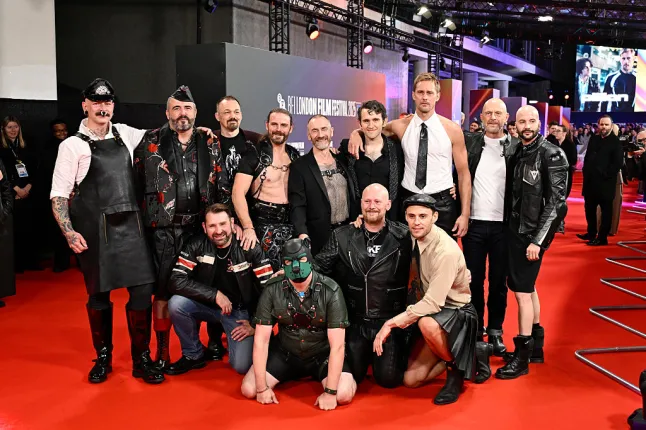
I don't think we need our kink narratives to be perfect. I don't think we need every dom to be a paragon of attunement or every sub to be navigating their desires from a place of total psychological health. People are messy. Dynamics are messy. And sometimes the most useful thing a film can do is hold that mirror up and say: yeah, this too. This also happens, do you want to work on it?
That's what Pillion did for me. It's nuanced and it's funny and it has Alexander Skarsgård in it, which is never not a selling point. I also am very susceptible to good marketing. Marketing it as a dom-com generally made my marketers brain deeply aroused. But more than that, it made me feel less alone in the specific, textured way that only good art about familiar things can. I hope it does the same for someone else. As I enter a season of my life where I'm exploring things entirely new to me in every avenue, in the bedroom, in my career, in my personal relationships, I can look at this film and find some peace in the discomfort and messiness I felt in it. May that be the case for you too — unless of course you're like, perfect.
Like what I have to say? Support me and subscribe to my newsletter.